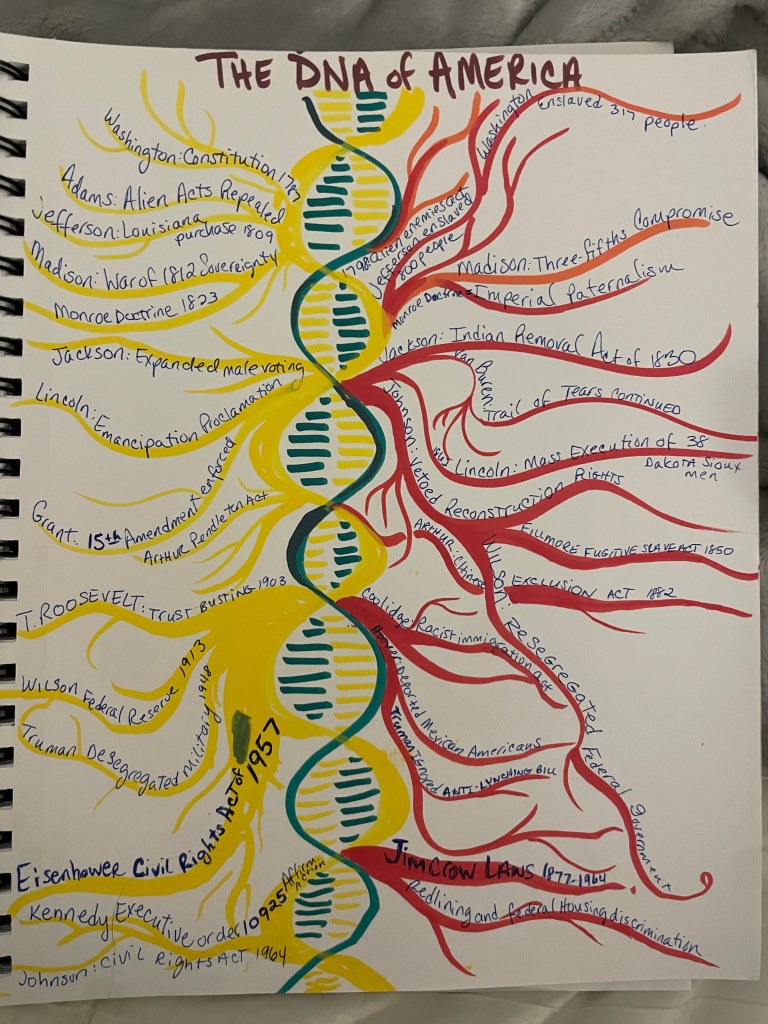
DNA of America is a visual journey through the nation’s history, represented as a giant DNA double helix stretching from the country’s founding to the present day.
The left strand traces America’s highest ideals and achievements: liberty, democracy, innovation, civil rights advancements, expanding opportunity, and the ongoing pursuit of a more perfect union.
The right strand reveals the nation’s contradictions: slavery, racism, segregation, exclusion, discrimination, violence, and persistent inequities that have shaped American life alongside its aspirations.
Connecting the two strands are the laws, court decisions, constitutional amendments, and government actions that have both reinforced and challenged these opposing forces. Some legal milestones codified injustice, while others dismantled barriers and expanded rights. Together, the intertwined strands illustrate how America’s story is not one of uninterrupted progress or unchanging oppression, but of a continuous struggle between its founding promises and its historical realities.
The double helix culminates in the present, showing that the nation’s DNA remains unfinished. The same structure that carries the legacy of freedom and equality also carries the imprint of racism and inequality. By placing these histories side by side, DNA of America invites viewers to examine how the past continues to influence the present and how future generations will shape the next chapter of the American story.
The DNA of American Medicine: Progress, Prejudice, and the Future of Health Equity
ESSENTIAL QUESTION:
How has American medicine inherited both healing and harm and what responsibility do we have to create a more equitable future?
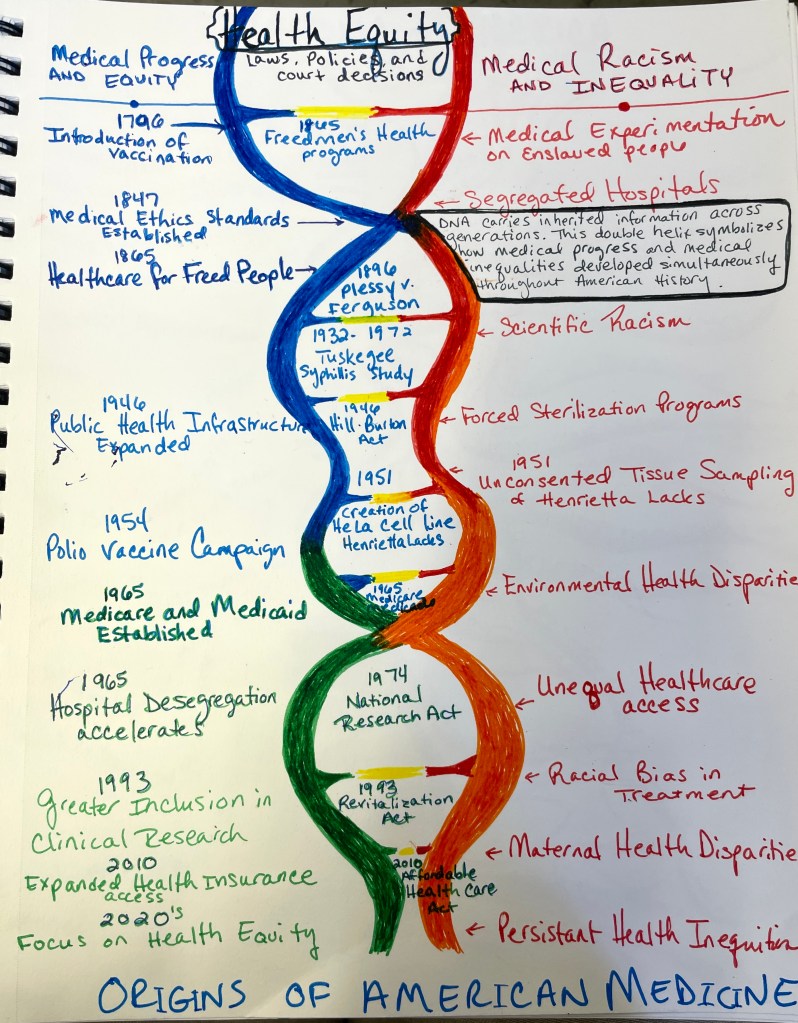
In this interdisciplinary humanities and biology project, students investigate the history of American medicine through the metaphor of DNA, exploring how medical progress and medical inequities developed simultaneously across U.S. history. Using a large DNA double helix as an organizing framework, students examine both life-saving scientific advances and the systems of exclusion, racism, and inequity that shaped healthcare access and outcomes.
Through historical research, biological analysis, ethical inquiry, and public storytelling, students investigate topics such as vaccination, public health reform, segregation in medicine, the Tuskegee Syphilis Study, healthcare desegregation, research ethics, maternal health disparities, and modern health equity movements. Students analyze how laws, court decisions, policies, and scientific developments shaped who had access to care—and who was harmed or excluded.
The culminating Exhibition of Learning transforms the classroom into an immersive museum experience featuring a collaborative DNA installation. Each student or team creates a museum-quality “DNA rung” or exhibit panel connected to a key historical moment, scientific breakthrough, ethical dilemma, or health inequity. Exhibits include historical artifacts, biological explanations, visual storytelling, interactive components, and future-facing solutions related to health justice. Visitors walk through the evolving “genetic code” of American medicine while students act as museum docents, helping audiences reflect on the question of what society inherits and what it chooses to change.

