Cultivating Authors of Change
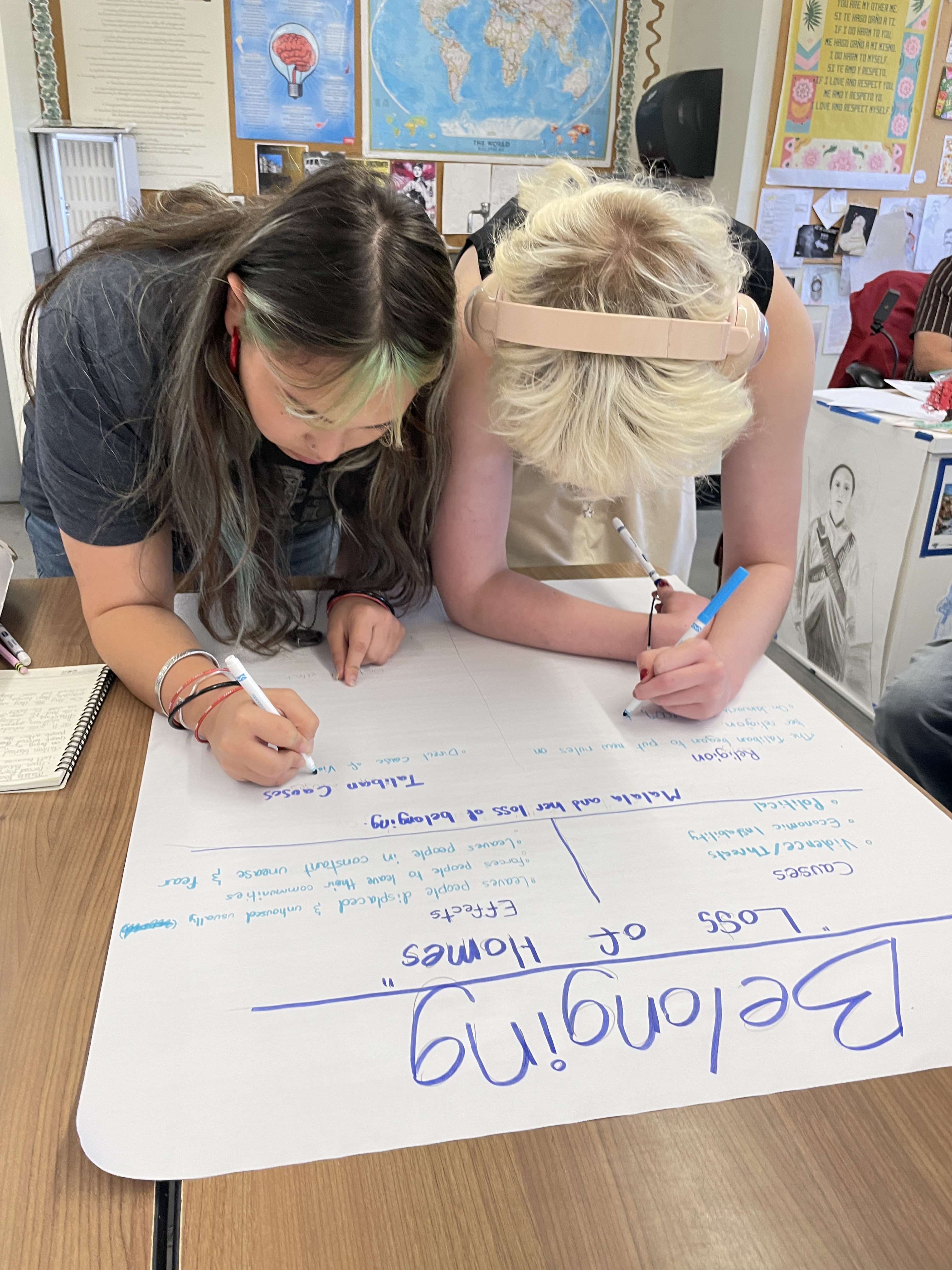
Nelson Mandela famously reflected, “Education is the most powerful weapon which you can use to change the world.” This conviction forms the foundation of my teaching philosophy. I am in my penultimate month as a Resident-Teacher in a Tenth grade World History class at High Tech High International, a project-based learning environment situated in a former Naval foundry in San Diego, California. Each of four classrooms consists of twenty-five (25) fifteen and sixteen year olds at one of the most pivotal developmental crossroads of their lives. They are negotiating identity, belonging, and purpose, while simultaneously being asked to perform academically in systems that were not always designed with them in mind. My students embody profound diversity: they differ linguistically, culturally, racially, and in the wonderfully varied ways they think and learn.
My positionality as a Mexican-American educator, mother of an eleventh-grader, pianist, artist, and lifelong learner, shapes everything about how I show up in my classroom. Growing up bilingual and bicultural, I know firsthand what it feels like to be on the edge of two worlds; to wonder whether my language, my culture, and my family’s stories belong in academic spaces. That experience is central to my teaching. It is why I am compelled to build classrooms where every student’s identity is treated as an asset and intellectual capital. Ladson-Billings (1995) explains that effective pedagogy must do more than raise achievement, it must also “help students to accept and affirm their cultural identity while developing critical perspectives that challenge inequities that schools (and other institutions) perpetuate” (p. 469) so that they may begin to see themselves as authors of change.
To cultivate this awakening, I intentionally anchor myself in a “Warm Demander” teacher presence (Hammond, 2014), creating a space where relentless care and high expectations coexist. My teaching philosophy rests on four interconnected High Tech High design principles: equity, personalization, collaborative design, and authentic work.
Equity
My understanding of equity has been fundamentally reoriented by Dr. Shelley Moore’s (2016) bowling analogy, which I encountered in my special education coursework. Dr. Moore describes teaching like bowling: when teachers aim for the middle of the lane, there are always pins left standing, typically the 7 and the 10, the students on the outside edges. But when the teacher changes the aim, curving the ball directly toward the hardest pin to reach, that is how you get a strike. That is Universal Design for Learning. As the CAST framework articulates, UDL is not a single solution but a set of principles for curriculum development that gives all students equal opportunities to learn (CAST, 2018). Ever since I internalized these ideas, I have intentionally designed lessons that target my most complex learners, students with IEPs, and emerging English Learners; knowing that when I do, the entire class benefits. A rising tide lifts all ships. Ever since I started doing this in every lesson, my student’s are accessing the material with more success and their work is improving along with their academic confidence.
One example of this was during my Propaganda in Architecture project, in which students investigated the political and cultural messages embedded in famous structures of power around the world. Drawing on the real-world writing framework of Gallagher (2011) and Gallagher and Kittle (2018), students analyzed authentic examples before constructing their own arguments. From the outset, I designed this unit for UDL with multiple means of engagement and multiple means of representation. All instructional materials were available in Google Classroom, and every resource was translated into Spanish to ensure full access for my Emerging English Learners. Key vocabulary was displayed on a physical word wall and posted digitally. For students with specific learning needs such as dyslexia, I provided speech-to-text tools, graphic organizers, and sentence starters. Every student received a structured slide template, I held five-minute individual writing conferences with each student to provide standards-based feedback, and all materials were available in print format upon request. The equity move behind this design is that no learner was left as the 7 or the 10 pin. By building the highest level of support from the beginning, every student had a genuine pathway to rigorous, meaningful work.
Personalization Meets Collaborative Design
Personalization within my learning environment reflects student choice, voice, and students’ cultural histories and traditions within academically rigorous inquiry. I design lessons that connect students’ identities, culture, and intellect so that students recognize their lived experiences as great assets. During a unit on the Mexican Revolution (1910-1920), students collaboratively designed culturally grounded Lotería cards representing revolutionary figures and concepts. Lotería is a traditional card game that soldiers and their families played during the Revolution; a living artifact of collective memory. The majority of our student body comes from collectivist relationship-centered cultures, so I leaned into that orientation. As Hammond (2014) explains, “culturally responsive information processing techniques grow out of learning traditions of oral cultures where knowledge is taught and processed through story, song, movement, repetitious chants, rituals, and dialogic talk” (p. 127). This structure reinforced collaboration, oral tradition, and mastery, consistent with Romero, Arce, and Cammarota’s (2009) framework of critically compassionate intellectualism, which positions students’ cultural identities as the engine of academic achievement.
Authentic Work
In deeper exploration of the Mexican Revolution, my students acted as archeologists of sound, peeling back the layers of history by listening and analyzing corridos. Corridos are an oral tradition that serves as both historical record and scathing social commentary embedded in Mexican culture. Many students were moved to discover the origins of songs they’ve sung since childhood. Kelly Gallagher (2011) argues that “beyond teacher modeling in the classroom, my students benefit immensely from closely examining writing from the real world” (p. 20). I drew upon students’ prior knowledge of the corridos as well as their previous knowledge of the Mexican Revolution, reflecting Romero et al.’s (2009) argument that a student’s cultural knowledge is not a barrier to academic achievement but its very foundation. Students then authored their own corridos, synthesizing content mastery, creative expression, and critical thinking into a single authentic act of deeper learning.
Reflection and Ongoing Growth
I am a first-year teacher, and with that comes both deep conviction and genuine humility. Looking honestly at my practice, one of my most vital daily structures is a two-part writing routine: students begin each class with a warm-up prompt that surfaces prior knowledge, and close with an exit ticket capturing what they now understand. This routine gives me real time formative data to adjust instruction and gives students daily practice in metacognition and self-directed learning; habits that extend far beyond my classroom. Gallagher (2011) captures my broader writing ambition: “Our students are not spending enough time in school learning how to evaluate those things we want them to critically judge for the rest of their lives – newscasts, Web sites, print ads, commercials, ballot propositions, and politicians” (p. 113). I am building towards this by studying Gallagher’s Write Like This framework and Gallagher and Kittle’s (2018) workshop model to develop more intentional instruction. I will continue to resist doing the thinking for my students. As Hammond (2014) reminds us, the Warm Demander does not simply care about students, she holds them accountable to their own brilliance. That is the teacher I wish to become, and I owe much to my Cooperating Teacher for being my guide, model and teacher.
References
CAST. (2018). Universal design for learning guidelines version 2.2. http://udlguidelines.cast.org
Gallagher, K. (2011). Write like this: Teaching real-world writing through modeling & mentor texts. Stenhouse Publishers.
Gallagher, K., & Kittle, P. (2018). 180 days: Two teachers and the quest to engage and empower adolescents. Heinemann.
Hammond, Z. (2014). Culturally responsive teaching and the brain: Promoting authentic engagement and rigor among culturally and linguistically diverse students. Corwin.
Ladson-Billings, G. (1995). Toward a theory of culturally relevant pedagogy. American Educational Research Journal, 32(3), 465-491. https://doi.org/10.3102/00028312032003465
Moore, S. (2016). One without the other: Stories of unity through diversity and inclusion. Portage & Main Press. Romero, A., Arce, S., & Cammarota, J. (2009). A barrio pedagogy: Identity, intellectualism, activism, and academic achievement through the evolution of critically compassionate intellectualism. Race Ethnicity and Education, 12(2), 217-233. https://doi.org/10.1080/13613320902995483

